


Purchasing from a new diaper brand carries inherent risks, but structured evaluation can prevent costly mistakes. By assessing product quality, supplier credibility, communication practices, pricing transparency, certifications, and pilot testing, brands can make informed decisions while minimizing financial and operational exposure.
1. Assess Product Quality Through Samples and Material Verification
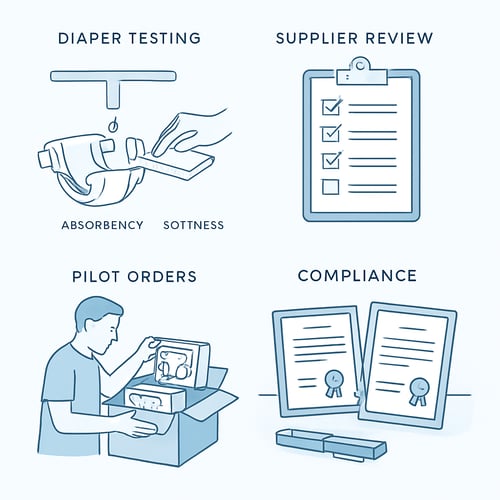
Begin by requesting samples of each SKU you plan to order. Evaluate absorbency, leak protection, softness, and fit against benchmark products already in the market. Comparing materials and overall performance allows you to immediately gauge suitability.
Look deeper into components: topsheet textures, core formulations, elastic materials, and backsheet quality. One European brand we consulted supplied a small sample batch that revealed minor leakage issues, which were resolved before full production, saving both time and money.
Certifications are another critical factor. ISO, CE, or local regulatory approvals indicate adherence to recognized standards. Cross-referencing certifications with actual sample performance enhances confidence in product reliability.
2. Verify Supplier Credibility and Operational Efficiency
Even excellent products can fail if the supplier lacks operational competence. Investigate their track record: years in business, previous clients, and distributor partnerships. Social proof and online reviews provide additional insight into reliability.
Communication is equally important. A dedicated account manager, timely updates, and clear documentation often signal that a supplier can handle multi-SKU orders and complex logistics. For instance, a North American brand avoided shipment delays during a multi-SKU launch thanks to proactive supplier communication.
Test responsiveness with small inquiries or sample requests. Suppliers who provide detailed production schedules and transparent logistics information demonstrate reliability beyond product quality.
3. Evaluate Pricing Transparency and Cost Structure
Initial cost can be misleading if suppliers include hidden fees. Request a full breakdown of unit costs, tooling fees, packaging charges, and shipping costs. Compare multiple quotes to spot inconsistencies and understand where savings or hidden expenses may lie.
For example, one startup discovered a seemingly low per-unit price included additional fees for certification verification and labeling, which increased the effective cost by 15%. Early clarification prevents budget surprises.
Negotiating flexible payment terms or smaller batch production can further reduce upfront financial exposure while maintaining access to quality materials.
4. Confirm Certifications and Compliance
Regulatory compliance is non-negotiable, particularly for international sales. Review ISO, CE, ASTM, or relevant local standards applicable to diapers. Certification documents should be current, verifiable, and traceable to the batch being produced.
In addition, ask for testing reports for absorbency, skin safety, and leakage under standardized conditions. A supplier who proactively shares lab test results and inspection data demonstrates commitment to quality and compliance.
Combining document verification with hands-on sample testing ensures you are not relying solely on certificates, which could be outdated or misrepresentative.
5. Conduct Pilot Orders and Market Testing
Before committing to large volumes, place a small pilot order. Monitor product performance, packaging quality, and customer feedback. This approach reduces financial risk and allows iterative improvements.
A European startup placed a 500-piece pilot order per SKU, collected feedback from online customers, and refined their core products and packaging. This minimized overstock risk and helped allocate resources to SKUs with proven market appeal.
Pilot testing also highlights operational issues like labeling errors, packaging inconsistencies, and shipment handling. Early identification allows adjustment before scaling, ensuring smoother future operations.
6. Evaluate Supplier Support for Scaling and Future Orders
Beyond the first order, consider the supplier’s capacity to support future growth. Ask about production lead times, batch scalability, and ability to accommodate seasonal fluctuations.
A brand’s first supplier might be ideal for a small launch but unable to scale rapidly when demand grows. Discuss long-term partnership potential and flexibility upfront to avoid bottlenecks later.
Strong supplier support contributes to brand stability and faster time-to-market for subsequent product launches.
Conclusion
Evaluating a new diaper brand is a multi-dimensional process. By combining quality assessment, credibility verification, pricing transparency, certification checks, pilot orders, and long-term supplier evaluation, brands can mitigate risk while preparing for scalable growth. Structured evaluation protects both financial investment and brand reputation, enabling confident market entry.
